

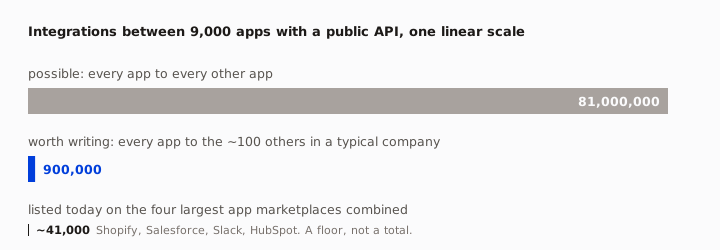
Every app with a public API can, in principle, exchange data with every other one. Zapier’s directory lists 9,000+ apps that do [1], and every ordered pair of them is a distinct piece of integration code: 81 million. Almost none of those pairs matter. Two apps only need to talk when the same company runs both, and the average company runs 101 apps [2]. Multiply through and the number of integrations worth writing is about 900,000. Nobody counts how many exist. The four largest app marketplaces list about 41,000 between them; a category-leading ATS lists 500; most of the 9,000 publish no marketplace at all. Integration Bench measures whether coding agents can close that gap.
Key takeaways
- 9,000 apps with a public API make 81 million ordered pairs. That is a ceiling, not a market size.
- An integration is wanted only when both apps sit in one company’s stack. At 101 apps per company, the pairs worth writing come to about 900,000, 1.1% of the ceiling.
- No one counts what has been built. Shopify, Salesforce, Slack and HubSpot list 41,000 apps combined and a category-leading ATS lists 500. Published counts fall well short of 900,000.
How many apps can be integrated at all?
Count apps that expose a working public API, because an integration cannot be written against anything else. The largest public list is Zapier’s directory: 9,000+ apps in 2026, up from 7,000 two years earlier [1]. It is a floor. Apps that never listed with Zapier (in-house systems, regional vendors, on-premise software with a SOAP endpoint) are missing, and every one of them still gets integrated by someone. HeyMilo’s oldest connector target, UKG Pro, first shipped in 1993 as UltiPro for LAN [8] and is not a Zapier app.
Integrations are directed. Pulling candidates from an ATS into an HRIS is different code from pushing hires from the HRIS back into the ATS, with different endpoints, different failure modes and often a different team maintaining it. So the space is ordered pairs, not combinations:
| Variable | Meaning | Value | Where it comes from |
|---|---|---|---|
| Apps with a working public API | 9,000 | Zapier app directory, 2026 [1]. Floor, not total. | |
| Other apps each one could talk to | 8,999 | Every app except itself | |
| Possible directed integrations | 80,991,000 | , rounded to 81 million |
Halve it for undirected pairs and you get 40 million. Either way, the figure describes what is possible, not what anyone wants.
Why most of those pairs will never be written
An integration has a customer only when one organisation runs both ends. Okta’s Businesses at Work 2025 puts the average customer at 101 apps [2], the first year over 100 after sitting below 90 from 2019 to 2023. Each app, then, realistically needs to talk to the roughly 100 apps beside it in a typical stack, not to all 8,999 others:
| Variable | Meaning | Value | Where it comes from |
|---|---|---|---|
| Apps with a working public API | 9,000 | Same as above [1] | |
| Apps a typical company runs | 101 | Okta, Businesses at Work 2025, global average per customer [2] | |
| Apps beside any given one in that stack | 100 | The stack minus the app itself | |
| Directed integrations worth writing | 900,000 | ||
| Share of the possible space that has a customer | 1.1% | 900,000 / 80,991,000 |
That is 1.1% of the ceiling. The number moves with the assumptions, but not by an order of magnitude. Stacks differ by company, so the union of “apps beside this one” across all customers is bigger than 100; demand also concentrates, because most stacks include the same handful of hubs, so the effective count per app is smaller than the union. Directed pairs give 900,000 and undirected pairs give 450,000. The answer is on the order of a million, not 81 million.
How many exist today?
No census exists. The visible floor is the marketplaces, and the counts are concentrated in a few platforms. Shopify’s App Store lists 25,690 apps (August 2026) [3]. Salesforce’s AppExchange, now folded into AgentExchange, carries 10,000+, and Slack 2,600 [4]. HubSpot lists 2,437 [5]. Four platforms, about 41,000 listings. One step down, a category leader like Greenhouse advertises 500+ pre-built integrations [6] and BambooHR about 150 [7]. Most of the 9,000 publish no marketplace and no count.
The published counts sum to tens of thousands of listings, against 900,000 pairs worth writing. The true built count is higher, because private and in-house connectors are never listed, but it is not close to 900,000. Two things follow. Most integrations a company would use do not exist as a pre-built connector. And the ones that exist were written many times over: every vendor builds its own connector to Salesforce, and every ATS builds its own to Workday. HeyMilo has written more than a hundred against applicant-tracking, HRIS and job-board systems, and most of those pairs also exist in some other vendor’s codebase.
What this means
The constraint is not API access. It is engineering time per pair: read the documentation, find where it is wrong, handle pagination, webhooks and rate limits, then maintain the connector when the vendor changes something unannounced. In HeyMilo’s experience each integration takes weeks of an engineer’s time. At that cost, 900,000 pairs is more work than the industry has ever staffed, which is why most of them do not exist.
If a coding agent can ship an integration that survives contact with the vendor, the economics of that number change. That is the specific claim Integration Bench tests: whether a model can deliver a connector that a vendor’s own request log says is correct. On the current leaderboard, the leader resolves 35 of 50 tasks (70%). Webhook tasks average 23.15, compared with 64.03 for polling. The 900,000 is the size of the problem those numbers are measured against.
FAQ
Why count ordered pairs instead of combinations?
Because the code is directed. Syncing A into B and B into A are separate implementations with separate endpoints, auth flows and failure handling. Using combinations halves both the possible and the worth-writing figures (40 million and 450,000) and leaves the ratio between them unchanged.
Why use Zapier’s directory for the number of apps?
It is the largest public list of apps with a verified, working API, and every entry has been exercised by a third party. Alternatives either count companies rather than APIs or count API endpoints rather than apps. The 9,000 is a floor; the argument survives if the true number is 15,000.
Why 101 apps per company?
It is the global average across Okta’s customer base in the 2025 Businesses at Work report [2], the broadest published measurement of stack size. Smaller companies run fewer, enterprises run several hundred. The figure sets the scale of “apps beside this one,” which is what decides whether a pair is worth writing.
Sources
- Zapier. App Directory, “9,000+ apps,” accessed 2 September 2026. Category counts on the same page sum past 9,000.
- Okta. Businesses at Work 2025, March 2025. Global average of 101 apps per customer, up 9% year over year; below 90 from 2019 to 2023.
- AppNavigator. Shopify App Store statistics, 25,690 published apps as of 28 August 2026.
- Salesforce Ben. AppExchange, Slack Marketplace, and the Agentforce Ecosystem Are “Now One”, 2026. “More than 10,000 Salesforce apps” and “more than 2,600 Slack apps.”
- HubSpot. App Marketplace, all apps, 2,437 listings, accessed 2 September 2026.
- Greenhouse. How we compare, “500+ pre-built hiring tech stack integrations.”
- Match VS. BambooHR vs Workday 2026, “150+ pre-built integrations” in the BambooHR marketplace. Secondary source; BambooHR does not publish a count.
- Ultimate Software Group. Form S-1, 1998. UltiPro for LAN first released in 1993.
Numbers in this post are the sources’ own figures at the dates given. The two equations are ours; change or and both results move linearly.